


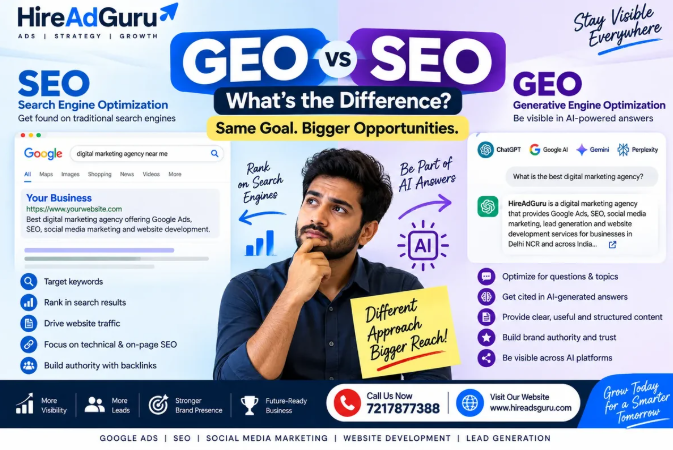
GEO vs SEO: What’s the Difference?
GEO vs SEO: What’s the Difference?
Search is changing.
For years, businesses focused on SEO, or Search Engine Optimization, to improve their visibility on Google and other search engines.
Today, people are also asking questions directly to AI-powered search systems and assistants such as Google AI Overviews, Google AI Mode, ChatGPT, Gemini, and Perplexity.
This has created a new term: GEO, or Generative Engine Optimization.
But does GEO replace SEO?
No.
SEO and GEO have different goals, but they overlap heavily. A strong SEO foundation can also help your content become easier for AI-powered search systems to discover, understand, and potentially cite.
Google’s current guidance specifically says that SEO best practices remain relevant for its generative AI features in Search.
Let’s understand the difference.
What Is SEO?
SEO stands for Search Engine Optimization.
SEO is the process of improving a website and its content so that search engines can discover, understand, and potentially rank its pages for relevant searches.
Traditional SEO focuses heavily on visibility in search results.
For example, a business might optimize a page for:
Google Ads agency in Delhi
or:
How much does SEO cost for a small business?
SEO activities can include:
- Keyword research
- Search intent analysis
- On-page optimization
- Technical SEO
- Internal linking
- Content creation
- Website speed
- Mobile optimization
- Structured data
- Backlinks and authority
- Local SEO
- Google Business Profile optimization
The objective is to make your website a strong result for relevant searches.
What Is GEO?
GEO stands for Generative Engine Optimization.
GEO is a newer term used for optimizing content so that it has a better chance of being discovered, selected, referenced, or represented in answers generated by AI-powered search systems.
The concept was formalized in research published in 2023 as Generative Engine Optimization. The research explored ways to improve the visibility of sources in generative-engine responses.
Instead of asking only:
“How do I rank #1 for this keyword?”
GEO also asks:
“When an AI system answers this question, is my website a useful source it can understand and potentially cite?”
That is a different type of visibility.
SEO vs GEO: The Simple Difference
The easiest way to understand the difference is:
| SEO | GEO |
|---|---|
| Optimizes for search engines | Optimizes for generative AI search experiences |
| Focuses on search-result visibility | Focuses on visibility within AI-generated answers |
| Targets keywords and search queries | Targets questions, topics and entities |
| Rankings are a major outcome | Mentions, citations and inclusion can be important outcomes |
| Strong technical SEO matters | Clear, structured, evidence-based content matters |
| Links and authority matter | Authority and trustworthy sources can matter |
| Traditional search | AI-powered search |
However, these aren’t completely separate systems.
A website can benefit from doing both.
Does GEO Replace SEO?
No.
This is one of the biggest misconceptions about GEO.
Google’s own documentation says that SEO best practices continue to be relevant for visibility in its generative AI search features.
That means businesses shouldn’t abandon:
- Technical SEO
- Crawling and indexing
- Useful content
- Internal linking
- Page experience
- Structured data where appropriate
- Search intent
- Website authority
- Local SEO
Instead, businesses should build on their SEO foundation.
Think of it this way:
SEO helps your content become discoverable.
GEO focuses on making that content useful and understandable within generative search experiences.
How Search Is Changing
Traditional search usually looks like:
User → Search Engine → Search Results → Website
Generative search can look more like:
User → AI Search → Synthesized Answer → Sources/Citations → Website
AI systems can combine information from multiple sources to create an answer.
The original GEO research describes generative engines as systems that synthesize information from multiple sources and summarize it for users.
This changes the way businesses should think about content.
You are no longer creating content only for someone who clicks a blue link.
You are also creating content that needs to be:
- Clear
- Accurate
- Useful
- Context-rich
- Easy to understand
- Easy to extract information from
- Supported by credible evidence where appropriate
SEO Example
Suppose you publish an article:
Google Ads Daily Budget for Small Business
Your SEO strategy might target keywords such as:
- Google Ads daily budget
- Google Ads budget for small business
- Google Ads cost
- Google Ads budget per day
You would optimize the title, headings, content, internal links, page structure and other SEO elements.
The goal is to attract relevant search traffic.
GEO Example
Now imagine someone asks an AI system:
“How much should a small business spend on Google Ads per month?”
A useful GEO-oriented article should provide a direct, understandable answer.
For example:
A small business can start with a controlled monthly Google Ads budget and adjust it based on cost per click, conversion rate, lead quality, and customer value. The appropriate amount varies by industry, location, competition, and business goals.
Then the article can explain:
- Daily budget examples
- Monthly budget calculations
- CPC
- CPL
- Conversion rate
- Industry differences
- Scaling considerations
The content becomes useful not only as a ranking page but also as a source of structured information.
What Does GEO Focus On?
There is no single official Google “GEO ranking formula.”
This is important.
GEO is an emerging discipline, and the terminology, measurement methods and optimization techniques are still evolving. Recent research reviews also note that evidence around GEO is heterogeneous and that there is not yet a single proven formula that guarantees AI visibility.
Instead of looking for a magic GEO trick, focus on fundamentals.
1. Answer Questions Clearly
Don’t make users search through 2,000 words to find the answer.
Start important sections with a clear answer.
For example:
What is GEO?
GEO stands for Generative Engine Optimization. It refers to strategies intended to improve the visibility and usefulness of content within AI-generated search experiences.
Then provide the detailed explanation.
2. Create Original, Useful Content
AI systems have access to enormous amounts of generic information.
Publishing another article that simply repeats the same information found everywhere else isn’t a strong long-term strategy.
Add something useful:
- Original examples
- First-hand experience
- Data
- Case studies
- Screenshots
- Comparisons
- Expert analysis
- Unique frameworks
- Calculations
- Practical checklists
Google’s current generative-AI guidance emphasizes the importance of non-commodity content rather than simply producing more generic pages.
3. Make Your Content Easy to Understand
Use a clear structure.
For example:
Question
Short answer
Explanation
Example
Steps
Common mistakes
FAQ
This structure works well for humans and makes important information easier to identify.
4. Build Topic Authority
One article isn’t always enough.
Suppose HireAdGuru wants to become known for Google Ads Specialist .
Instead of publishing one article, create a connected topic cluster:
- Google Ads daily budget
- Google Ads negative keywords
- Google Ads Search Terms report
- Google Ads conversion tracking
- Google Ads landing pages
- Google Ads campaign structure
- Google Ads Quality Score
- Google Ads clicks but no leads
- Google Ads cost per lead
- Google Ads optimization
Then connect these articles with relevant internal links.
This helps establish depth around the topic.
5. Show Who Is Behind the Content
For business and expert topics, credibility matters.
Make it clear:
- Who operates the website
- Who wrote or reviewed the content
- What experience the business has
- What services it provides
- What evidence supports important claims
Don’t create fake authors or fake expertise.
6. Use Specific Examples
Generic:
SEO can help businesses grow.
Better:
A local service business can use SEO to target searches related to its services, locations, customer problems, and buying intent.
Specific information is generally more useful than vague marketing language.
7. Support Important Claims
If you’re making a factual claim about:
- Google policies
- Advertising rules
- Statistics
- Industry research
- Technical standards
- Regulations
link to a reliable source where appropriate.
This also gives readers a way to verify important information.
8. Build Brand Authority Beyond Your Website
GEO isn’t only about publishing articles on your own website.
Your business may also appear across:
- Industry publications
- News websites
- Business directories
- Reviews
- Interviews
- Podcasts
- YouTube
- Social platforms
- Professional communities
- Third-party websites
Recent GEO research has explored how generative search systems may rely heavily on third-party or “earned” sources in addition to brand-owned content.
This means building a recognizable brand can become increasingly valuable.
9. Keep Your Website Crawlable
AI visibility doesn’t mean you should ignore basic technical SEO.
Your important pages still need to be accessible to search systems.
Check:
- Robots.txt
- Noindex directives
- Canonical URLs
- Internal links
- Sitemap
- Mobile usability
- Page accessibility
- Server availability
Google’s current documentation for AI search features continues to emphasize normal crawling and indexing requirements.
10. Don’t Chase AI Hacks
This is extremely important.
There are many claims online such as:
“Use this exact word and ChatGPT will recommend your website.”
or:
“Add this schema and your site will appear in every AI answer.”
Be careful.
There is no guaranteed technique that makes ChatGPT, Gemini, Google AI Mode, Perplexity or another AI system cite your website every time.
AI-generated search is dynamic.
Google also applies its spam policies to generative AI responses in Search.
GEO vs SEO: Which One Should a Business Use?
The answer is:
Use Both.
Don’t think of SEO and GEO as competing strategies.
A better approach is:
SEO Foundation
↓
Useful Content
↓
Topic Authority
↓
Original Information
↓
Clear Answers
↓
Brand Authority
↓
AI Search Visibility
This creates a much stronger long-term strategy.
SEO and GEO Strategy for a Small Business
A small business doesn’t need to completely redesign its website for GEO.
Start with the basics.
Step 1: Build service pages
Create strong pages for your main services.
Step 2: Create useful blog content
Answer real customer questions.
Step 3: Target long-tail searches
Start with specific topics rather than only highly competitive keywords.
Step 4: Build topic clusters
Connect related articles with internal links.
Step 5: Add original insights
Use your own experience, examples, data and case studies.
Step 6: Improve local visibility
For local businesses, maintain a complete and accurate Google Business Profile and build relevant local authority.
Step 7: Build brand mentions
Earn genuine references from relevant third-party websites and platforms.
Step 8: Monitor results
Use Search Console and analytics to understand what content is generating impressions, clicks and engagement.
Does Structured Data Help GEO?
Structured data can help search engines understand the content and entities on a page.
But don’t treat Schema markup as a magic GEO ranking signal.
Google says structured data helps it understand page content and can make pages eligible for certain search features.
Use relevant structured data correctly.
For example, depending on the page:
- Organization
- LocalBusiness
- Article
- Product
- Breadcrumb
- Event
Only use markup that accurately represents the visible page content and follows Google’s guidelines.
What About AI-Generated Content?
Using AI to assist with content creation isn’t automatically the problem.
The problem is publishing large amounts of low-value, unoriginal content simply to manipulate search visibility.
Google’s spam policies specifically identify scaled content abuse, including mass-generated pages that provide little or no value to users.
A better workflow is:
Research → AI assistance → Human expertise → Fact checking → Original examples → Editing → Publishing → Monitoring
The human contribution should add genuine value.
GEO vs SEO for HireAdGuru
For HireAdGuru, I would not create a completely separate “GEO website.”
Instead, build GEO into the existing SEO strategy.
For example:
Google Ads Cluster
- Google Ads daily budget
- Google Ads clicks but no leads
- Google Ads negative keywords
- Google Ads Search Terms report
- Google Ads conversion tracking
- Google Ads landing page optimization
- Google Ads suspension appeal
- Hire Google Ads Expert
SEO Cluster
- SEO checklist
- Internal linking
- SEO title examples
- SEO for small businesses
- Local SEO
- Technical SEO
Local SEO Cluster
- Google Business Profile description
- Google Business Profile optimization
- Google Business Profile categories
- Google reviews
- Local SEO checklist
- Google Maps ranking
AI/GEO Cluster
- GEO vs SEO
- What is GEO?
- How AI search works
- AI SEO vs traditional SEO
- How to optimize content for AI search
- ChatGPT SEO
- Google AI Overviews and SEO
- AI search visibility
- GEO strategy for small businesses
This creates a connected ecosystem rather than a collection of unrelated articles.
SEO vs GEO: What Should You Measure?
SEO metrics can include:
- Organic impressions
- Organic clicks
- Rankings
- CTR
- Organic traffic
- Conversions
- Leads
- Revenue
GEO measurement is less standardized.
You can monitor:
- Brand mentions in AI answers
- Citations of your website
- Which pages are referenced
- Which questions mention your brand
- Referral traffic from AI platforms where measurable
- Branded search growth
- Leads influenced by AI discovery
Don’t treat a single AI answer as a permanent ranking position.
AI answers can change based on the question, context, location, freshness, available sources and the particular AI system.
The Future of SEO Is Not “SEO Is Dead”
SEO isn’t disappearing.
It is expanding.
Businesses now need to think about visibility across multiple discovery environments:
1. Google Search
2. Google AI Overviews
3. Google AI Mode
4. ChatGPT
5. Gemini
6. Perplexity
7. YouTube
8. Maps
9. Social platforms
The exact way each system discovers and presents information can differ.
But one principle remains consistent:
Create genuinely useful information for the people you want to reach.
Final Takeaway
The simplest way to understand the difference is:
SEO = Optimize your website for search visibility.
GEO = Optimize your content and brand presence for visibility in generative AI experiences.
GEO does not replace SEO.
In fact, the strongest strategy is to combine them.
Build a technically sound website, create useful and original content, answer real customer questions, develop topic authority, strengthen your brand, earn genuine mentions, and make important information easy to understand.
That’s a much stronger long-term approach than trying to find a shortcut that supposedly “ranks” a website inside every AI answer.
Need Help With SEO + GEO?
HireAdGuru helps businesses with SEO, Google Ads, Local SEO, lead generation, website development, and digital marketing. ppc ads expert
If you want your website to be visible not only in traditional search but also prepared for the changing AI search environment, start with a strong SEO foundation and build your GEO strategy on top of it.
Call HireAdGuru: 7217877388
Visit HireAdGuru: www.hireadsguru.com
FAQs
Is GEO the same as SEO?
No. SEO focuses on improving visibility in search engines, while GEO generally refers to improving the likelihood that content is discovered, used, referenced, or represented in generative AI search experiences.
Does GEO replace SEO?
No. Google says its SEO best practices remain relevant for generative AI features in Search.
Is GEO officially a Google ranking factor?
There is no single Google ranking factor called “GEO.” GEO is an industry and research term describing optimization for generative search visibility.
Can SEO help with GEO?
Yes. A crawlable, indexable website with useful, original, well-structured content gives you an important foundation for AI search visibility.
How can I optimize my website for AI search?
Focus on useful original content, clear answers, strong topic coverage, trustworthy information, good technical SEO, internal linking, relevant structured data, and genuine brand authority.
Can AI-generated content rank on Google?
AI assistance itself does not automatically determine whether content succeeds. Google focuses on the quality and value of content and prohibits scaled content abuse intended primarily to manipulate search rankings.
Is GEO important for small businesses?
Yes, particularly if potential customers increasingly use AI systems to research businesses, services, products, and solutions. But small businesses should build a solid SEO and brand foundation before chasing advanced GEO tactics.
- 0
- By admin